
-1.jpg)
Predictive IT uses AI to spot the warning signs of a failure before it happens, so problems get fixed before they ever reach your team. Where proactive IT prevents the issues you already know about, predictive IT forecasts the ones you cannot yet see. It is the difference between a provider that keeps things running and one that keeps your business running without you noticing the work at all. (You will also see it called predictive IT support, AIOps, or predictive IT operations.)
Most people do not want IT. They want the things IT makes possible: staff who can work, systems that stay up, a business that does not stop. It sounds obvious, but it is the reason IT has kept changing shape over the years. Each step has moved further away from "fix it when it breaks" and closer to "make sure it never breaks in the first place".
A recent post, What proactive IT support actually looks like, covered proactive IT and how it heads off the problems you can usually see coming. This post picks up where that left off, at the next step: predictive IT, and the part AI plays in making it possible.
How has IT matured over time?
It helps to see the whole ladder, because predictive IT only makes sense as the top of it.
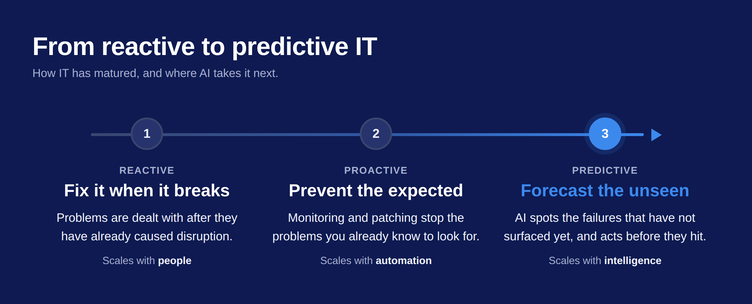
Reactive IT responds after something has already failed. A server goes down, someone raises a ticket, an engineer fixes it. It works, but the damage, the downtime and the disruption have already happened by the time anyone acts. This is the traditional model: it scales by adding more people.
Proactive IT prevents the problems you can anticipate. Monitoring, patching, standardising the repetitive work so known issues are handled before they cause trouble. This is where most good providers sit today, and it is a genuine step up. It scales through automation rather than sheer labour.
Predictive IT goes one step further. Instead of acting on the problems you already know about, it forecasts the ones that have not surfaced yet, reading patterns across your systems to prevent issues before they have any impact at all. It scales through intelligence, which is the part AI makes possible.
What is predictive IT, actually?
Predictive IT is the use of AI to analyse the data your systems produce, recognise the early signals that usually precede a failure, and act before that failure occurs. The industry also calls this AIOps, or predictive IT operations. It is the same idea in plainer terms.
The cleanest way to tell it apart from proactive IT is this. Proactive IT handles what usually goes wrong: it knows that unpatched software is a risk, so it patches. Predictive IT forecasts what is about to go wrong on your specific systems: it notices that one particular drive is showing the subtle read-error pattern that tends to come before a failure, and flags it for replacement while everything is still running normally.
Proactive asks "what commonly breaks, and have we covered it?" Predictive asks "what is about to break here, and can we get ahead of it?"
At a glance:
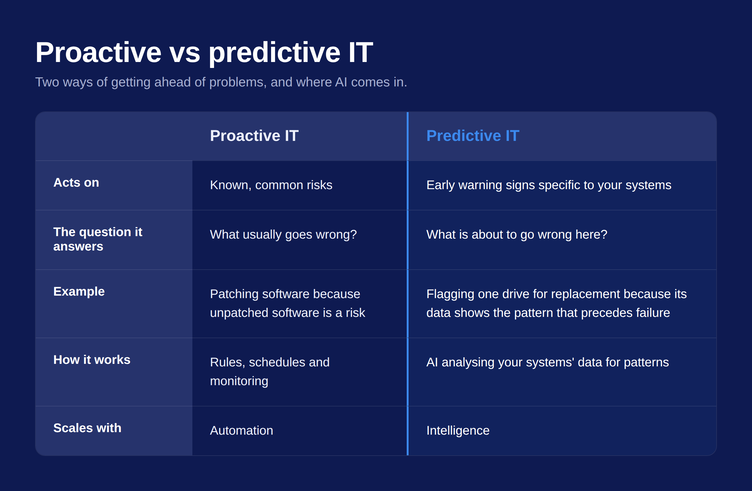 The two are not rivals. Predictive IT builds on proactive foundations rather than replacing them, a point worth holding on to and one this post comes back to.
What does AI actually do in predictive IT?
Here is what that actually looks like, because AI is not guessing. It does a handful of specific jobs with the large amount of data a modern technology estate produces, and it does them across the whole estate, not just the laptops: endpoints, servers, network connections and security systems alike.
Anomaly detection. Every device, connection and system produces a constant stream of telemetry, whether that is a laptop, a network link or a set of security logs. AI learns what "normal" looks like for your environment and flags the small deviations that a human watching dashboards would never catch in time.
Forecasting hardware failure. Drives, batteries and components show measurable warning signs before they fail. A hard drive reports its own health through the S.M.A.R.T. standard (Self-Monitoring, Analysis and Reporting Technology): rising read error rates, reallocated sectors, spin-up time and operating temperature. AI reads these signals across thousands of devices, spots the combination that tends to precede a failure, and flags the part for replacement while it is still working.
Capacity and performance trends. Rather than waiting for a system or a network link to run out of headroom and grind to a halt, AI projects usage forward and flags the point at which you will need to act, so it can be planned rather than rushed.
Continuous optimisation. Because the analysis never stops, small inefficiencies get surfaced and corrected over time, rather than building up until they become a problem.
In each case, predictive IT scales with intelligence rather than headcount. It does not need more people watching more screens, because the system does the watching.
Why does a provider have the advantage here?
Predictive IT has one hard requirement: data, and a lot of it. AI can only forecast a failure if it has seen enough examples to recognise the pattern. That is difficult for a single in-house team looking after one estate, because they simply do not see enough of it.
A provider does. Looking after many organisations means seeing failures, anomalies and warning signs across a very large base of devices, connections and systems, which is exactly what makes the predictions accurate. It is one of the few real edges an external provider has over an internal team, and to be straight about it, that comes down to scale rather than cleverness.
What are the limits?
Predictive IT is powerful, but it is not a crystal ball, and we would not pretend otherwise.
It is probabilistic, not certain. AI raises the likelihood of catching a problem early; it does not guarantee that nothing will ever fail. Some failures give no warning at all.
It needs human judgement on top. A prediction is only useful if someone decides what to do with it, weighs it against the cost and disruption of acting, and knows when a flag is worth chasing and when it is not. The AI narrows the field; people still make the call.
And it does not replace the foundations. Predictive IT sits on top of solid proactive and reactive foundations, it does not remove the need for them. Anyone selling predictive AI as a reason to neglect patching and monitoring has the order wrong.
If a provider tells you their AI means nothing will ever go wrong, be sceptical. The truth is more useful: far fewer surprises, and far more problems caught while they are still small.
Where is predictive IT heading?
Predictive IT is not the end of the journey. AI in this space has moved in one direction for years. First it helped engineers work faster. Then it took on routine work under supervision. Now it predicts and prevents problems before anyone feels them.
The human role does not disappear as this happens. It moves up a level. People shift from firefighting tickets to overseeing the system and handling the exceptions that genuinely need a person. The businesses that benefit most are the ones whose provider treats the technology as something people steer, not something left to run unwatched.
What does this mean for you?
Forget the technology for a moment. The difference this makes to a business is easy to see.
Fewer surprise outages, because the failures that would have taken you offline are caught before they do. Hardware replaced on a planned basis before it dies, rather than in a panic after it has. Costs that can be budgeted for instead of landing as emergencies. And, across the board, less firefighting, which means your own people spend their time on the work that actually moves the business forward.
That brings it back to where we started. You do not want IT effort. You want the outcomes, and predictive IT, done properly, is one of the clearest ways to deliver them.
If you would like to talk through what predictive IT could look like across your IT, connectivity and security, get in touch with our team.
Frequently asked questions
What is the difference between proactive and predictive IT? Proactive IT prevents the problems you already know to expect, through monitoring, patching and standardised maintenance. Predictive IT uses AI to forecast problems that have not yet surfaced, by spotting the early warning signs in your systems' data and acting before any impact.
Does predictive IT replace proactive IT? No. Predictive IT sits on top of proactive and reactive foundations, it does not remove the need for them. The foundations still matter; predictive IT adds a further layer of foresight above them.
How does AI predict IT failures? AI analyses the continuous stream of data your devices and systems produce, learns what normal looks like for your environment, and recognises the patterns that tend to precede a failure. It can then flag a likely issue, such as a drive that is about to fail, while everything is still running normally.
Is predictive IT reliable? It is probabilistic rather than guaranteed. It significantly increases the chance of catching a problem early, but no system can predict every failure, and human judgement is still needed to decide how to act on what the AI flags.
Do I need a large business to benefit from predictive IT? No. The advantage comes from the provider's scale, not yours. Because a provider sees failures and warning signs across many organisations, the predictions work for businesses of any size, including SMEs.